
FPSO Engineering Myths: The Things Everybody Knows
When I first arrived at MTL, coming from a background in photography, film and drone work, I quickly learned that offshore engineering has a folklore all of its own. There are certain things that everybody knows. Or, at least, things that have been repeated so often that somewhere along the way we all stopped asking whether they were actually true.
In all honesty, this is hardly unique to our industry. Every walk of life has its myths (I can think of a few from film and photography that I believed for far longer than I care to admit). A statement gets repeated, gathers a little more authority with every telling and, before long, questioning it feels rather more radical than simply nodding along.
The trouble is, steel and seawater care very little for conventional wisdom. In an offshore context, an untested assumption can cost time and money, or even worse. So it absolutely always pays to check.
Welcome to MTL Myth-Busters
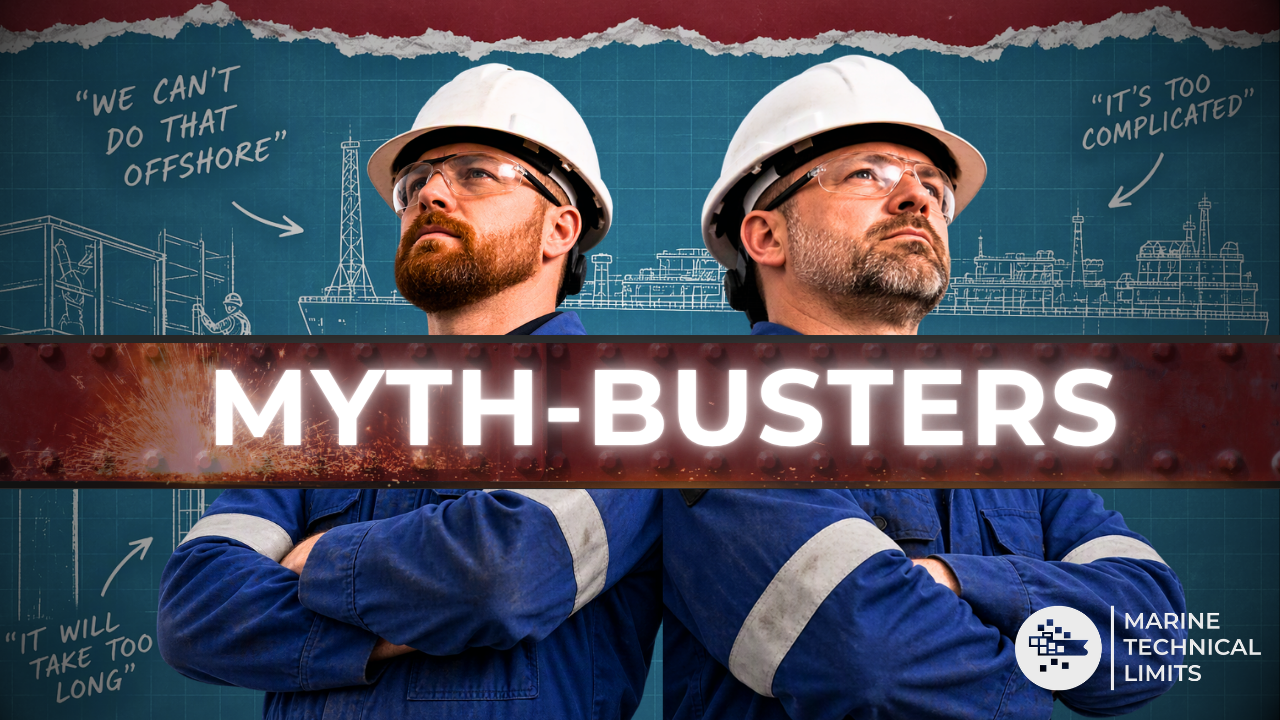
Enter Myth-Busters: our new blog mini-series, in which we take some of the familiar assumptions surrounding work on FPSOs and put them under a little pressure, to see whether they can bear the weight of scrutiny.
Here at MTL, much of our work exists precisely because offshore engineering so rarely fits into neat boxes. Ageing assets, awkward access, operational constraints and the plain reality of carrying out work miles out at sea all have a stubborn habit of complicating what looked perfectly straightforward on paper.
So it seems to me that “Is that actually true?” might be one of the most useful questions any of us can ask. Over the coming weeks we will put it to some of the most common misconceptions in the industry and bust a few of the bigger ones along the way.
The Myths on Trial
Across the series, members of the MTL team will each take a closer look at a claim connected with offshore engineering and execution:
- Pre-heat on welding
- NDT after 48 hours
- Low-voltage lighting
- Cutting with gas
- Working in confined spaces is dangerous
Each one gives us the chance to look past the headline and drill down to the facts beneath, to see what actually happens in practice, rather than what we have always been told happens.
Some may turn out to hold a grain of truth, while others may have grown out of practices that made perfect sense once upon a time but deserve a fresh look now. And occasionally, something that sounds entirely reasonable will not survive its first encounter with engineering reality. (Those, I suspect, will be the most fun to write about!)
The People Behind the Answers
I wrote recently about the stories that already live within organisations like ours. They are found in the experience of the people doing the work: the lessons learned offshore, the problems that demanded an unusual solution, the technologies that changed what was possible, and those moments when someone had the nerve to question the obvious answer.
Myth-Busters is another way of telling those stories.
Yes, there will be technical detail, and plenty of it. But there will also be experience, opinion and, I hope, the odd challenge to conventional wisdom. After all, doesn’t any industry move forward when experienced people are willing to put its assumptions to the test, rather than repeating them indefinitely?
First into the spotlight is pre-heat on welding. Matt Lewin kicks things off soon by taking this familiar piece of accepted wisdom back to the engineering behind it, and asking the question at the heart of the whole series: is it actually true?
Welcome to MTL Myth-Busters. I hope you’ll follow along.
About the Author

NICK FRANKS is Marketing and Communications Coordinator at Marine Technical Limits. With over a decade of experience working as a freelance content producer in photography, writing and film, he excels in taking raw ideas and helping them fly. Nick’s happy place is deep in the Scottish mountains with a flask of coffee and a drone.